
Designing a Compliant Global Gold Marketplace
A regulated commodity trading platform built from a compliance tracking tool for regulators into a full marketplace. Includes problem identification, real-world pivot, patent filing, system architecture, UX design, and live pilot with government-monitored participants across Africa and UAE.
Independent miners produce gold with no reliable path to legitimate markets
Artisanal and small-scale mining (ASM) accounts for roughly 20% of global gold production and supports 15–20 million miners, predominantly in sub-Saharan Africa. Yet the supply chain connecting mine to market is fragmented, opaque, and structurally resistant to compliance.
Buyers such as refineries and jewelry manufacturers have no reliable way to verify origin, ethical sourcing, or regulatory compliance before committing capital. Miners have no access to global buyers or fair pricing. Exporters operate as informal intermediaries with no consistent accountability infrastructure. The result: smugglers enter legitimate supply chains and their illicit “dirty” gold enters the global market mixed in with compliant “clean” gold.
The problem isn't the gold. It's the absence of a trusted, structured, universally accepted means of exchange that makes compliance economically viable for everyone in the supply chain.
Compliance is not a value proposition for a miner with no buyer
GoldChain did not start as a marketplace. It began with the need to automate the export and import documentation process and share that data with investors backing the project. The first iteration was a form on the company website, but that only solved the data collection step. Later the blockchain component was added as a ledger to record gold transactions.
And as I interacted with others in the industry, I recognized the demand from regulators and end buyers for verifiable data on where gold came from and how it moved through the supply chain. The gap was impossible to ignore: buyers wanted origin data, regulators wanted audit trails, but no tool existed to produce either in a format that both trusted.


A compliance tool only works if the people generating the data have a reason to use it. Compliance alone is not a value proposition for a miner in DRC.
The insight that drove the pivot: the tracking system needed a primary use case that served producers directly. Something that gave miners a reason to be on the platform independent of compliance. The blockchain record could be a byproduct of that activity, not the main event.
The Pivot: GoldChain was transformed from a tracking tool to a commodity marketplace. The “eBay for gold.” Producers list gold and access verified international buyers. Buyers get protection through escrow and verified chain-of-custody. Exporters have a structured platform to operate through. Every transaction is recorded on the blockchain, but that record is now a byproduct of commerce, not a compliance burden imposed from above. Everyone in the chain has a direct economic reason to participate.
The Result: By designing the marketplace first, the provenance data generates itself. The compliance follows commerce, not the other way around. Producers list to sell, not to comply. The blockchain record is created as a byproduct. Regulators and end buyers get the audit trail they need because every participant had an economic incentive to be on the platform, without compliance being the product.
The marketplace allowed compliance to become a byproduct of every transaction
GoldChain is a B2B regulated marketplace structured like eBay for physical gold, with compliance and verified chain-of-custody built into every transaction as a function of how the market operates, not as a requirement imposed on top of it.
The Core Insight: The barrier to ethical sourcing isn’t willingness, it’s incentive. If you give participants a platform where the path to market access runs through verification, where verified producers get better prices, verified buyers get protected capital, and the platform enforces escrow and documentation, the market self-selects toward clean trade.
Various user types and permission layers, one shared data model underneath
Most marketplace products are designed around the transaction. GoldChain is designed around the verification. Every feature, permission set, and UX decision flows from the question: who has been verified to do what, and what happens if they haven’t?
Each role has a distinct onboarding flow, document checklist, and trust score. Permissions expand progressively as verification tiers are completed, a design decision that reduces fraud without adding friction for compliant participants.
International trade requirements, simplified to five steps a rural miner can complete
The transaction architecture is where UX and compliance intersect. The challenge was designing a flow that meets international trade documentation requirements while remaining usable by a mining cooperative operator in rural DRC.
- Producer lists a shipment: Upload mine documentation, weight, purity assay, and origin certification. System assigns a blockchain reference ID to the lot.
- Platform verification layer: Documents checked against third-party verification partners and OECD/FATF frameworks. Trust score updated. Listing made visible to approved buyers.
- Buyer places purchase order: Buyer reviews chain-of-custody record, verifies documentation, and initiates order. Funds held in escrow and not released to producer until all conditions are met.
- Delivery and quality confirmation: Buyer confirms receipt and quality match against the original assay. Dispute window opens and any discrepancies trigger mediation before escrow release.
- Escrow released and settlement completed: Funds released to producer and exporter per pre-agreed split. Full transaction record immutably logged. Certificate of compliant trade issued.

Users never see the compliance layer, only a checklist and a clear next step
The hardest UX challenge in GoldChain was designing for a user base that spans rural African mining cooperatives and institutional commodity buyers in Dubai. These users have radically different in technical literacy, device access, and compliance familiarity, but are sharing the same product.
Transforming abstract regulatory complexity into structured workflows was the design principle that resolved this tension. Users never see a compliance framework. They see a checklist, a progress indicator, and a clear next step.
An incentive model, not just a revenue model
GoldChain’s revenue model is designed to align incentives. The platform earns only when compliant trade completes. This alignment is both a product principle and a trust signal to participants.
Transaction fee: Percentage of completed transaction value. Applied at escrow release. No charge on failed or disputed trades, which reduces platform risk abuse.
Verification tier: Premium verification tiers for producers who want accelerated trust scores and priority listing. Funded by margin improvement from accessing premium buyers.
Institutional API: Data and compliance API access for refineries, banks, and government departments that need chain-of-custody records without operating on the platform directly.
Country partner: Licensing model for governments seeking to operationalize mineral export compliance frameworks. GoldChain as the turnkey compliance infrastructure for a country’s ASM sector.
Every exclusion was a deliberate product decision
Every product is defined as much by what it excludes as what it includes. These are the significant design and architecture decisions made during development.
Built
Blockchain for chain-of-custody transaction records. Immutable, auditable, and credible data for institutional buyers and regulators. Used as trust infrastructure, not an add-on marketing feature.
|
Excluded
Consumer-facing gold buying. The complexity of retail KYC for individual buyers would have diluted compliance standards and revealed industry pricing, creating a different product entirely.
|
Built
Escrow-protected payments instead of direct peer-to-peer settlement. Adds friction, but protects both parties and is a prerequisite for institutional buyer participation.
|
Excluded
Crypto settlement. Despite the blockchain infrastructure, fiat escrow was chosen first to maintain regulatory credibility with government partner departments in the pilot.
|
Built
Supply-side first. Onboarded producers and exporters first before activating retailer-facing features. Marketplace liquidity requires supply density before demand can convert.
|
Excluded
Open marketplace listing during testing. All participants in the pilot are invited and manually verified. No self-serve onboarding until trust architecture is validated at scale.
|
Two patents and a registered trademark cover the method, not just the interface
The IP strategy reflects the product architecture. Protection is built around the system and method, not the visual design. A competitor can copy the interface, but they cannot copy the patented tracking and verification process.
- Patent Pending: Blockchain-Based Mineral Supply Chain Tracking and Authentication System (Patent Pub. No. US 2025/0384451)
- Patent Filed: Blockchain-Based Marketplace for Provenance-Verified Mineral Commodities (Patent App. No. 19/440,853)
- Trademark Registered: GoldChain® (Trademark Reg. No. 7,533,507)
Government-monitored pilots require controlled conditions
Everything from concept to pilot management
GoldChain was conceptualized, designed, patented, trademarked, and built under my sole product ownership. The work was not a design exercise or a speculative concept. It is a live, operational product with real participants and regulatory engagement.
- Problem Discovery: Direct observation of ASM supply chain failures. The gap between what buyers needed and what the market could prove was the founding insight.
- Product Strategy: Market framing, user role definition, business model, pivot decision, and go-to-market prioritization.
- UX Design: Full information architecture, flow design, wireframing, and iteration based on user testing with producers and exporters.
- UI Design: Complete visual system, component library, and responsive implementation.
- Brand: Logo, identity system, and trademark strategy.
- IP Filing: Patent application, system and method for tracking system and mineral marketplace. Trademark filed to protect brand name. Navigated USPTO requirements.
- Web Presence: Website strategy, copywriting, and design. Repositioned from blockchain-first to marketplace-first messaging (www.goldchainblock.io).
- Development: Product specification, developer coordination, QA, and iterative build across app and web.
The screens below walk through the marketplace from every angle: producer, exporter, admin, and end buyer. Each one reflects a specific design decision made to reduce friction for the user in front of it while keeping the compliance layer intact behind the scenes.
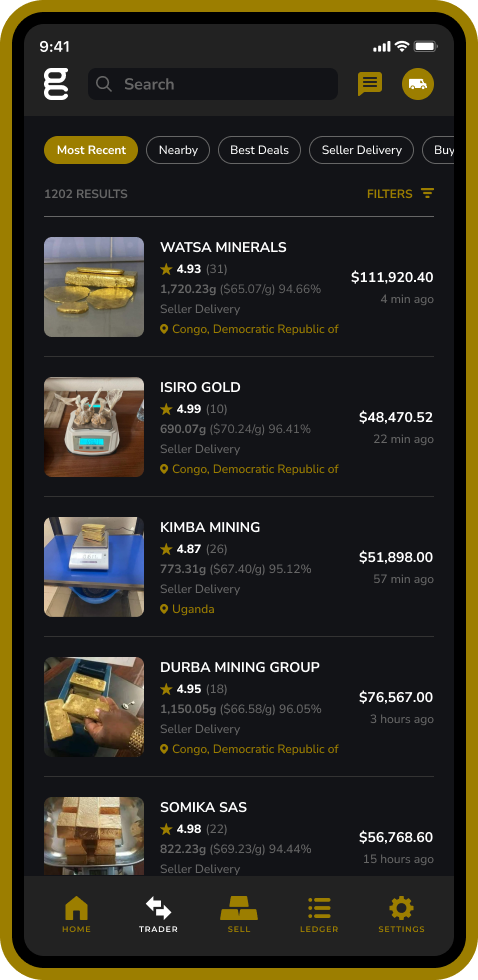
Marketplace Listings: The browse experience at the heart of the marketplace. This is where buyers shop available gold listings. The design borrows the familiarity of a consumer marketplace but layers in the signals that matter in commodity trading: trust tier, certification status, and available quantity.
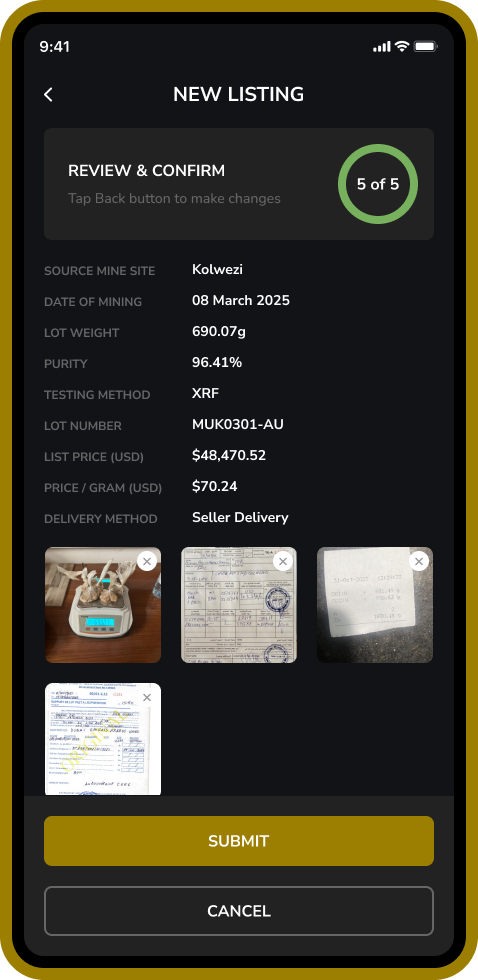
Create a Listing: By the time a producer reaches this screen, they’ve entered shipment data, uploaded documentation, selected delivery method, and confirmed Clean Gold status. The review screen makes the whole submission feel considered, not rushed. It gives the user one clear moment to verify before committing.
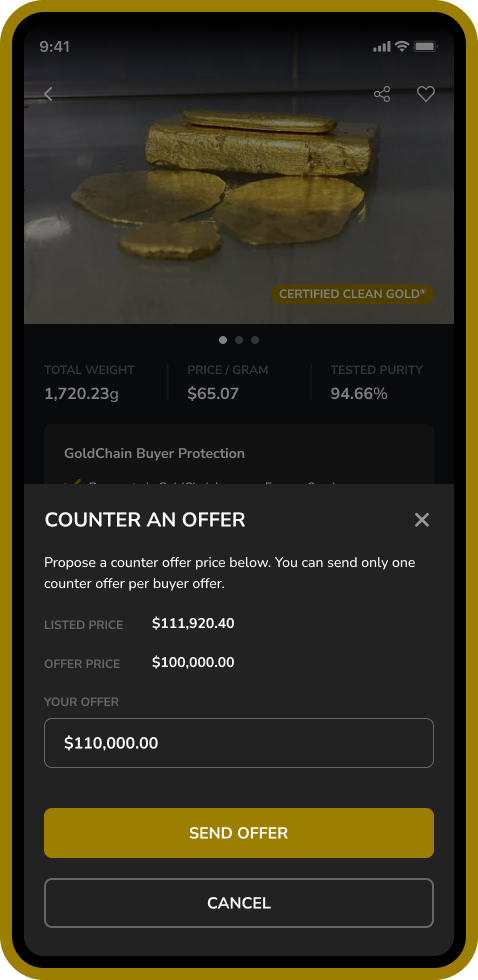
Offer Negotiation: This is the screen that makes GoldChain a marketplace and not just a tracker. Sellers can view incoming offers, counter, accept, or decline with the full listing context visible alongside the negotiation. The offer flow is designed so that every action is one tap, but nothing is irreversible without confirmation.
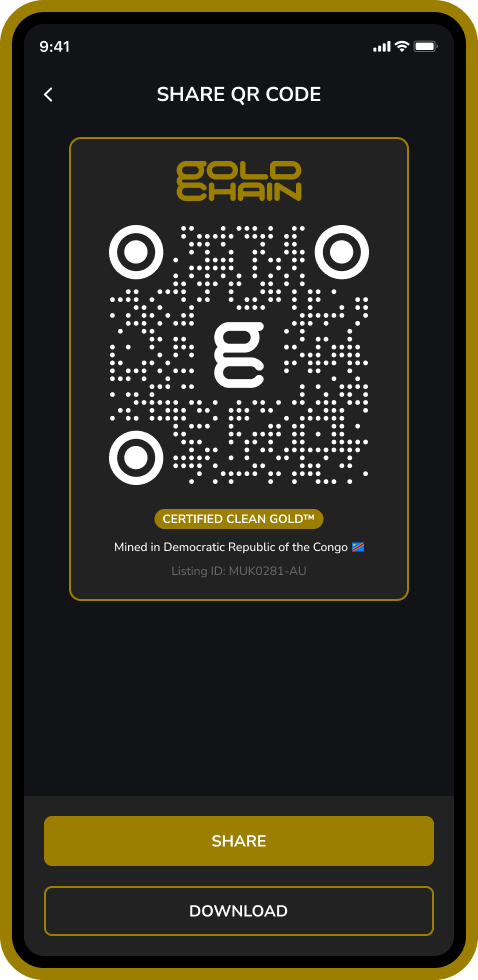
Ledger QR Code: Every completed transaction generates a unique QR code tied to that lot’s full blockchain record. Scan it and you get the complete chain of custody. This screen is the bridge between the marketplace and the compliance layer, and it’s the deliverable that matters most to institutional buyers and regulators.
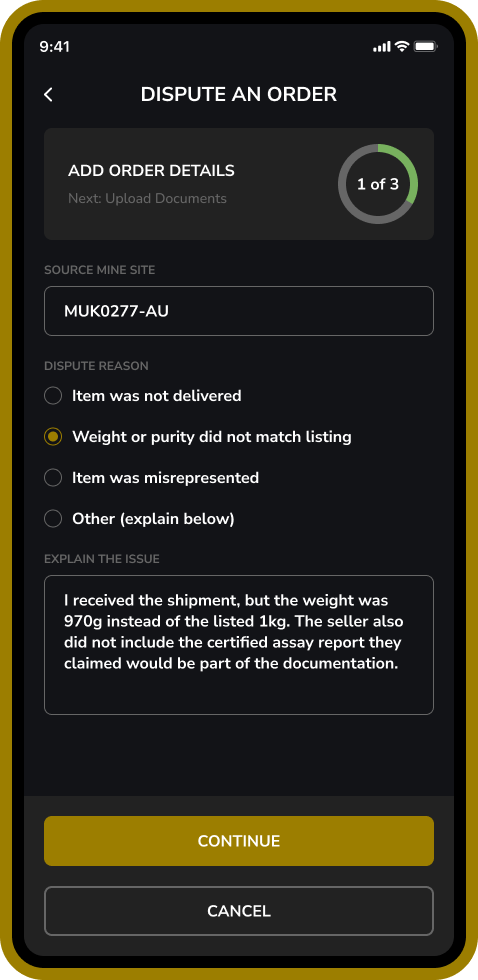
Order Dispute: Most products treat disputes as an afterthought. In a cross-border commodity marketplace, they’re a core use case. This screen gives exporters a structured path to file a dispute without it feeling adversarial. Designed to protect both parties and keep transactions moving toward resolution.
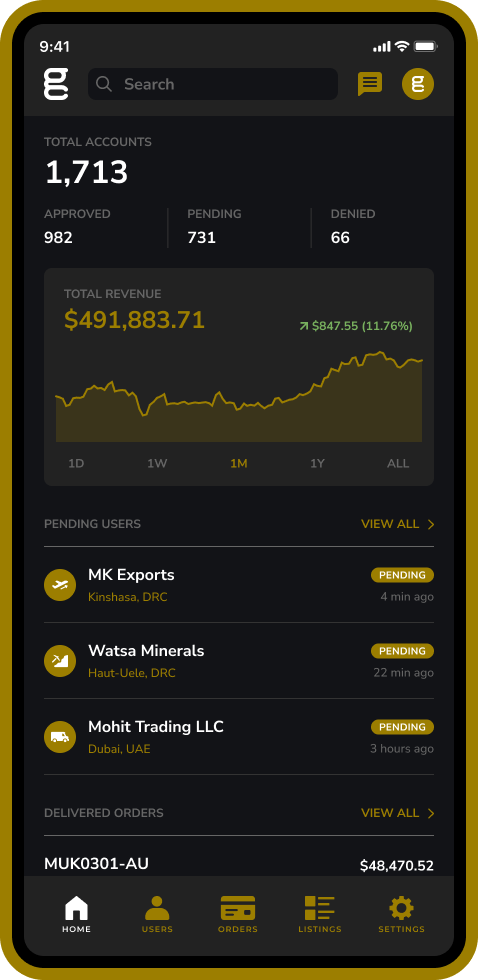
Admin Dashboard: The oversight layer that runs the whole operation. Admins can review pending user verifications, monitor active orders, flag suspicious listings, and manage the platform from a single view. The dashboard is role-restricted, not accessible by users, and every action taken here creates an audit trail.
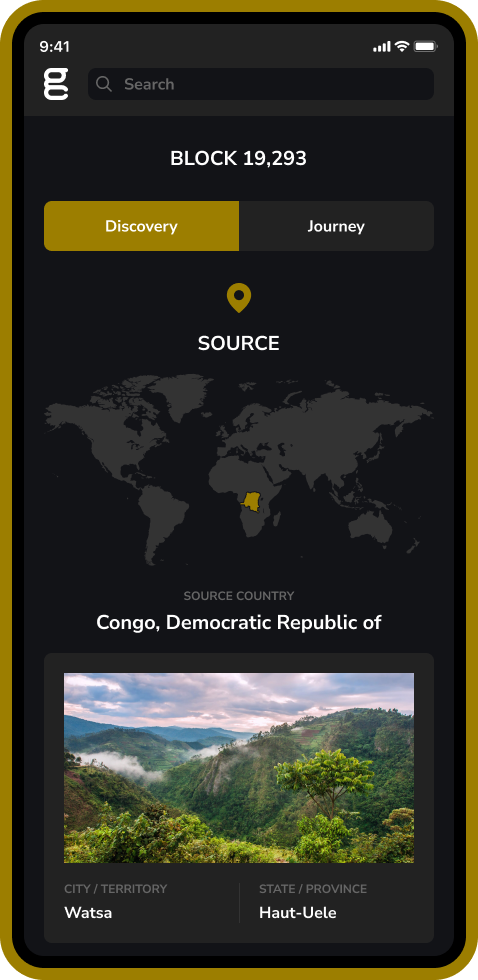
Public View: The screen a jewelry buyer in Tokyo or a refinery in Switzerland sees when they scan a QR code or receive a provenance link. The full journey of that gold from the mine, through the exporter, to their door, presented clearly and without jargon. This is the end of the chain and the proof of the whole system working as intended.
TakeawaysBuilding GoldChain from the ground up, and then rebuilding it after the market told me the first version wasn’t working, is the project that shaped how I think about product design. The original tracking tool was polished and technically sound, but nobody at the start of the supply chain wanted to use it. That failure was more valuable than any design decision I made, because it forced a fundamental question: who actually benefits from this, and when? Pivoting to a marketplace gave every participant a direct economic reason to be on the platform, and the compliance data (the thing regulators and end buyers actually needed) became a byproduct of commerce rather than a burden imposed on top of it. That’s the lesson I carry into every product now. Compliance, trust, and transparency don’t get adopted because they’re the right thing to do. They get adopted when they’re built into something people already want to use.