
BuyerCheck screens property buyers so real estate brokers can meet legal requirements without slowing the deal. I designed it end to end and drove it through launch.
buyercheck.ae >01 / big idea
A background check tells you about a person. BuyerCheck tells you whether to proceed.
A new law made every UAE broker responsible for screening buyers for money laundering. Brokers aren’t compliance officers, and what they needed wasn’t more information. They needed a decision they could act on and defend to a regulator.
02 / my role
- Researched UAE law, real estate rules, and FATF guidance with the firm’s attorneys
- Designed every broker, admin, and government screen
- Designed the risk scoring model and the enhanced report
- Built it with Claude Code and Codex, connecting 12 screening-data APIs
- Onboarded the first brokerages and the government accounts
- 8Seconds for a standard screening, down from a 48-hour review
- 14Seconds for an enhanced report when a buyer needs a closer look
- 1,000+Buyer screenings run since launch
03 / Problem
A new law, and no tool built for it
UAE brokers had new anti-money-laundering duties and nothing practical to meet them with.
Federal Decree-Law No. 10 of 2025 requires real estate brokers and developers to screen every buyer and to report suspicious transactions through the government’s goAML portal. Most agencies were getting by with Google searches, PDF checklists, and background-check services built for other industries. Enhanced due diligence reports were written by hand, outsourced at high cost, or skipped.
- Regulatory gap
A law without a workflow
No product combined screening, reporting, and filing in one place a broker could use.
- Market gap
Tools built for banks
Existing AML platforms were priced and designed for financial institutions, not agents handling many individual buyers.
- Operational gap
Manual work at scale
Agencies with dozens of agents screened hundreds of buyers by hand, with no consistent output.
- Data gap
No audit trail
Without structured records, an agency had nothing to show a regulator who asked for proof.
04 / Key insight
Speed is the compliance product
The first version worked like the services it replaced. A government official showed me why that would fail.
Version one sent each screening to one of the firm’s attorneys and delivered a reviewed report within 48 hours. That matched everyone’s idea of a background check. In a demo, a government official pointed out that the buyer is sitting across the desk. If a check interrupts the deal, brokers put it off, and a check put off becomes a check skipped. So I dropped the review queue and redesigned the whole product around an answer that arrives while the broker is still in the flow.
If the broker has to wait, the broker will skip it. The screening had to be instant.
05 / Decisions
Built for the people answering to regulators
Standard results in 8 seconds
- Noticed
- A check that takes longer than the conversation with the buyer gets put off, and a check put off gets skipped.
- Decided
- Run every source at once and show the screening working in the broker’s flow, with no reload, queue, or email to wait for.
- Result
- A standard screening returns in about 8 seconds, from buyer name to decision.
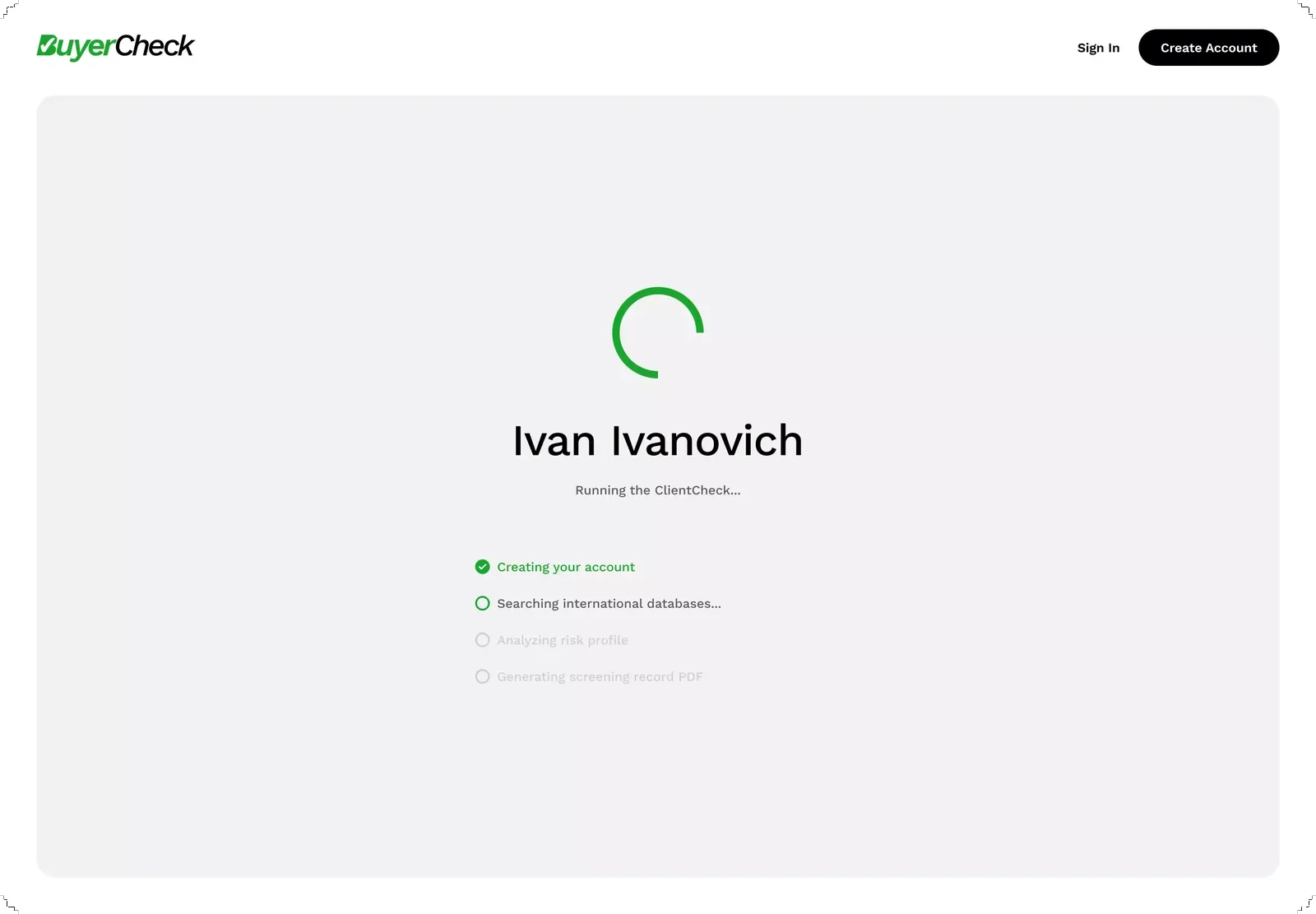
The screening runs while the broker watches
A clear status, not a report
- Noticed
- Brokers are not compliance officers. A background check gave them facts about a person but no answer on whether to proceed.
- Decided
- Lead every result with one of three states, cleared, review, or blocked, and show which of the four checks raised it.
- Result
- A broker can read the result while the buyer is still across the desk, and knows exactly what to do next.
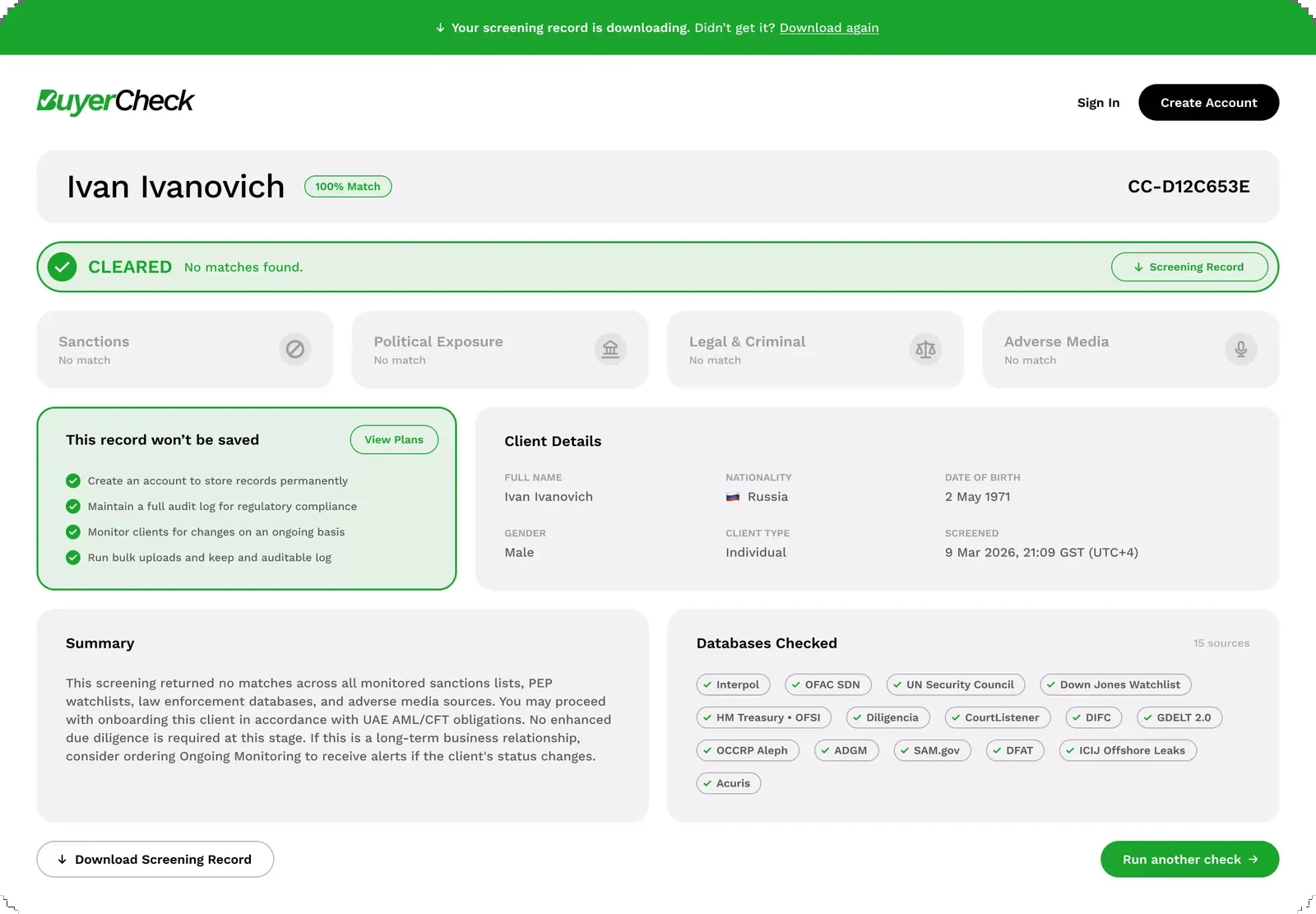
Cleared in seconds, with every database checked
A person decides the close calls
- Noticed
- Names repeat, spellings vary across alphabets and documents, and a watchlist hit can be close without being the same person. An algorithm alone would either flag innocent buyers or miss real ones.
- Decided
- When a screening returns more than one possible match, mark it for review and let the broker compare each match against the buyer’s details before clearing or escalating.
- Result
- Clear buyers move on in seconds, and the uncertain ones get a human decision that’s recorded with the screening.
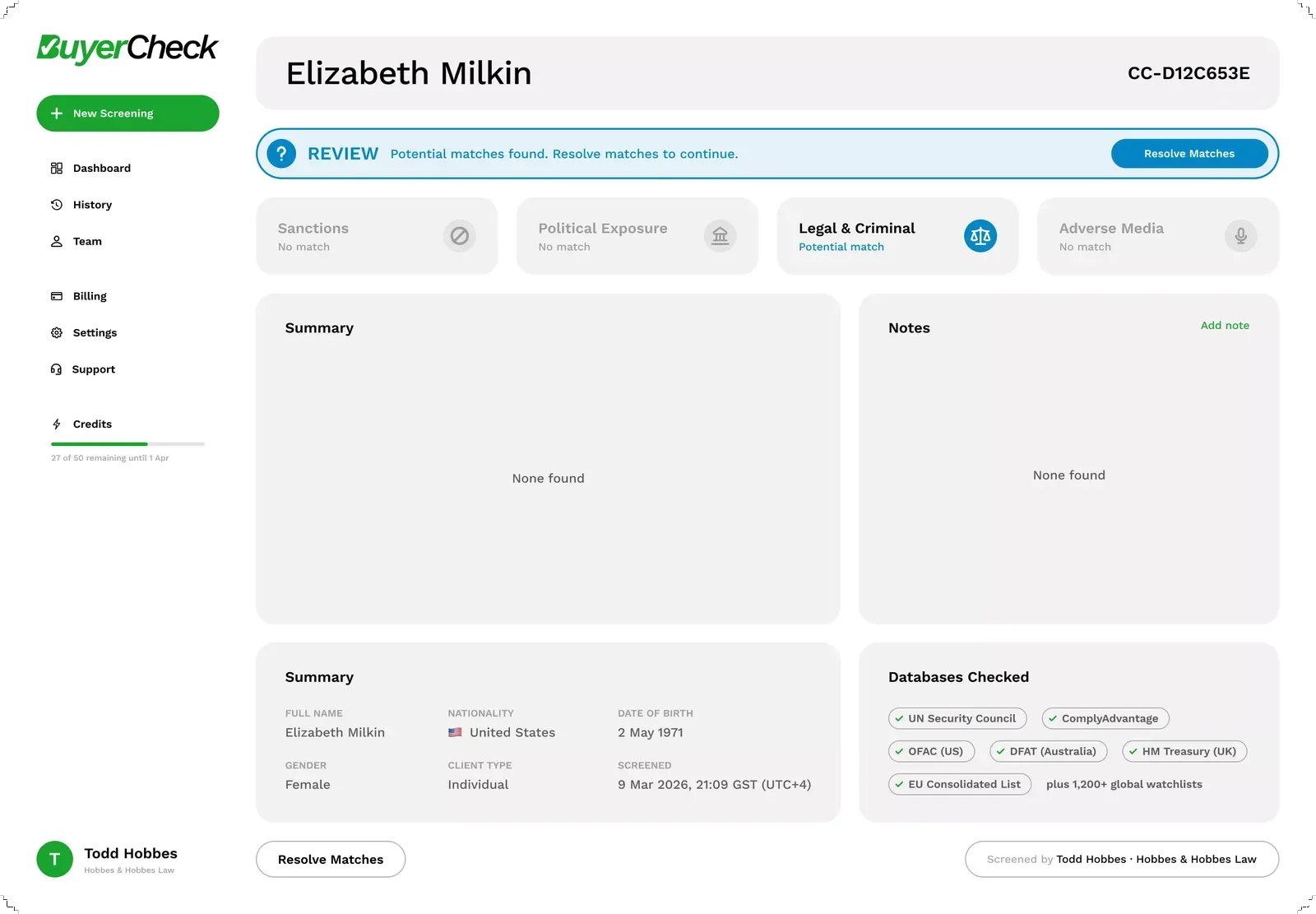
Review, possible matches for the broker to resolve
Scores a regulator can follow
- Noticed
- An inspector can ask a broker to explain any result. A score from an AI model can’t be explained or repeated.
- Decided
- Score enhanced reports with fixed weights across six risk areas, sanctions, source of funds, reputation, PEP status, the transaction, and geography. The same input always gives the same score.
- Result
- Every enhanced report is explainable, repeatable, and ready for an audit, without anyone writing it by hand.
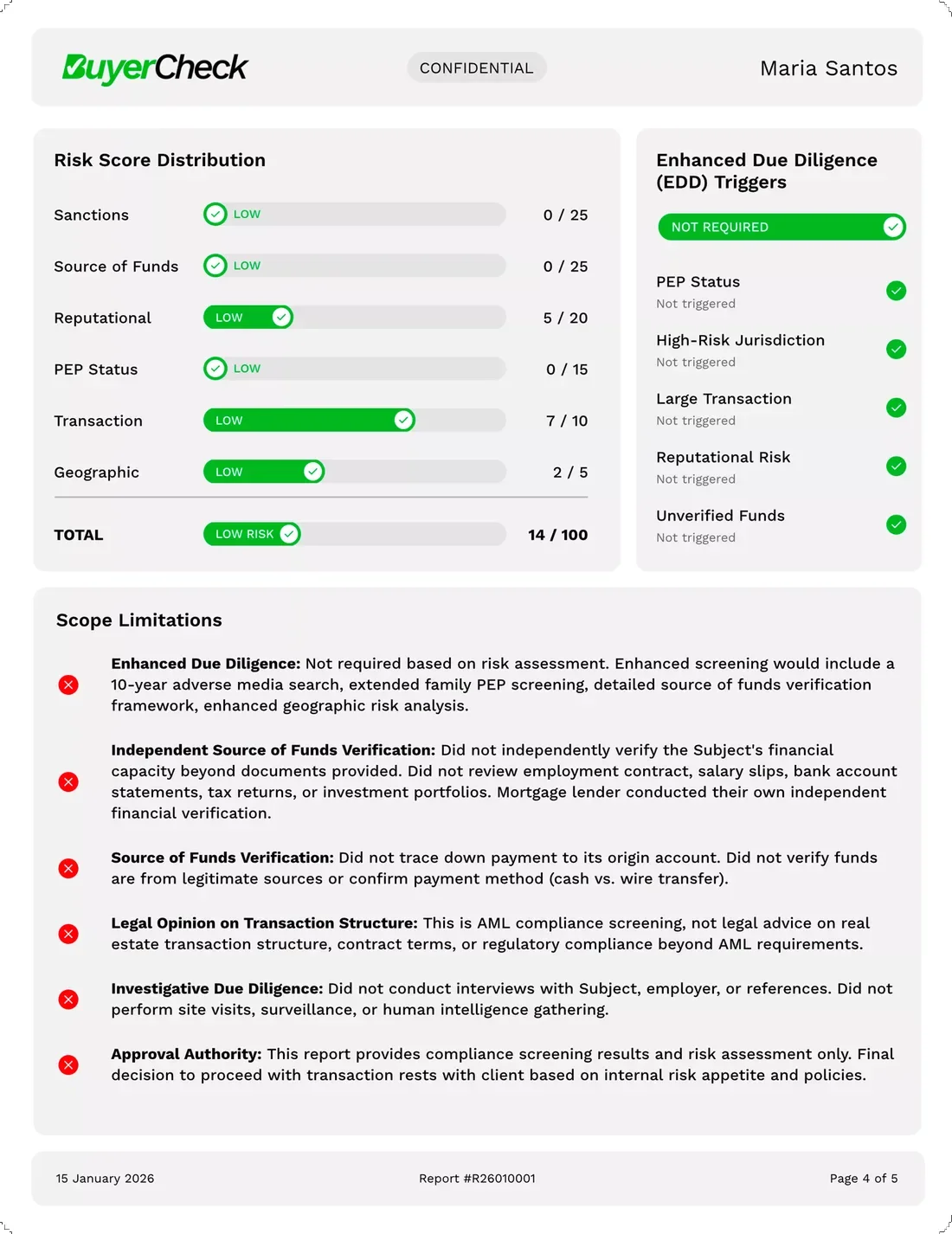
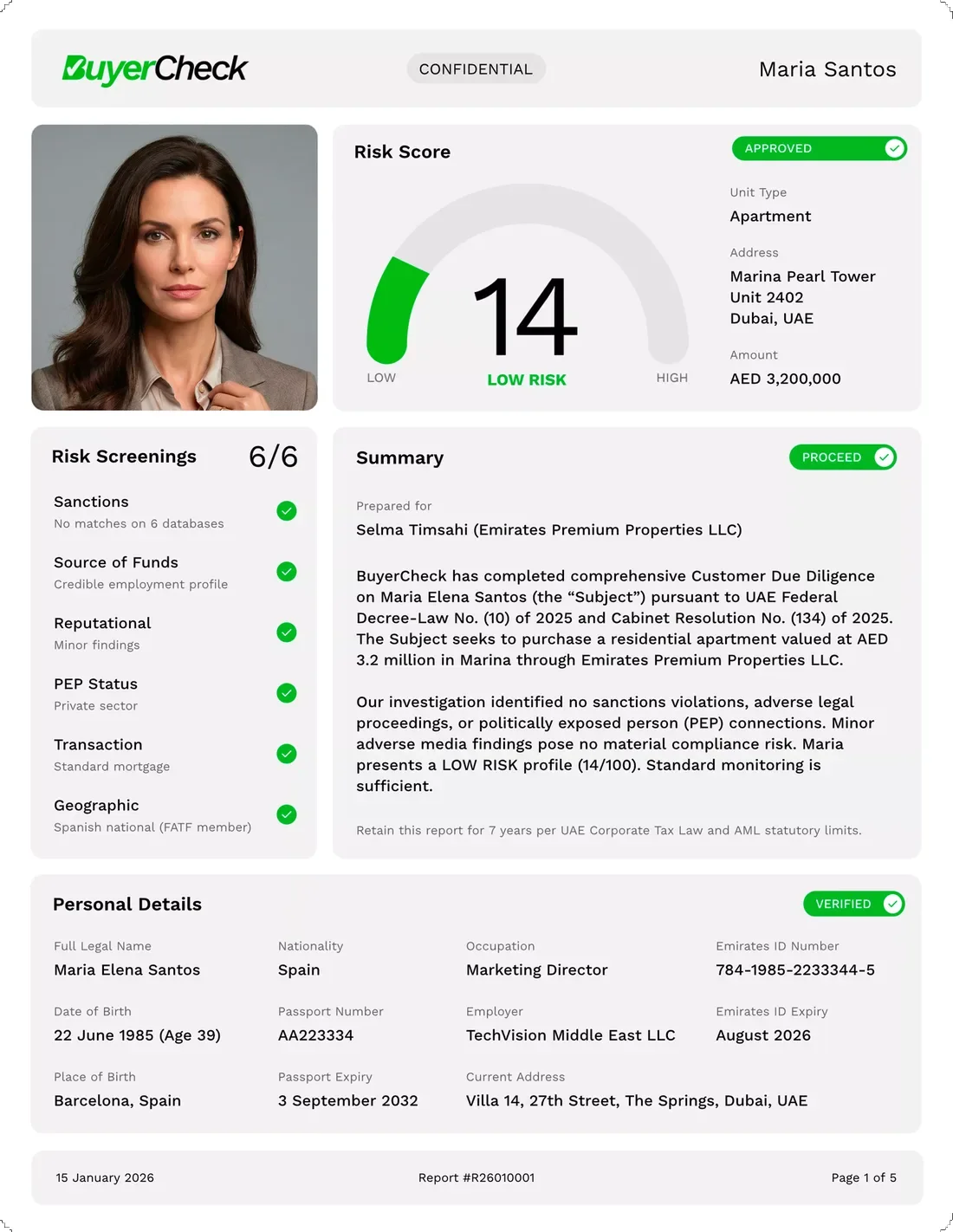
Records for the agency, not just the agent
- Noticed
- Agency owners needed to see their whole team’s screenings and what was waiting on them.
- Decided
- Add a dashboard of what needs attention, and a full screening history with CSV export for compliance reviews.
- Result
- Every screening is saved with time, risk, and broker, ready to hand to a regulator.
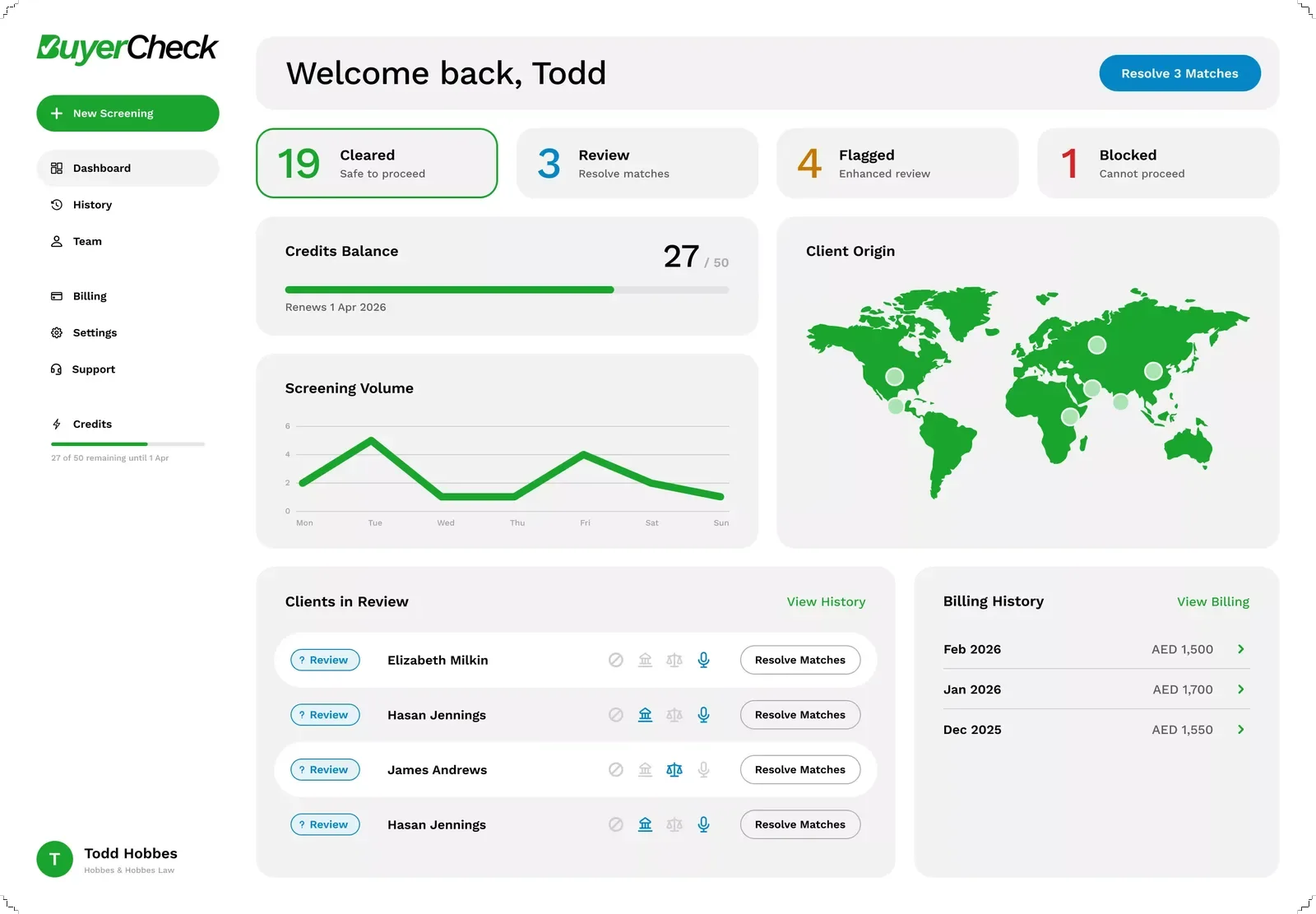
Dashboard, what needs attention today
Built for high-volume agencies
- Noticed
- Large agencies screened hundreds of buyers, and entering them one by one didn’t scale.
- Decided
- Add bulk upload from a spreadsheet template, with each buyer’s progress shown as it runs.
- Result
- An agency can screen a whole pipeline of buyers at once and get the same record for each one.
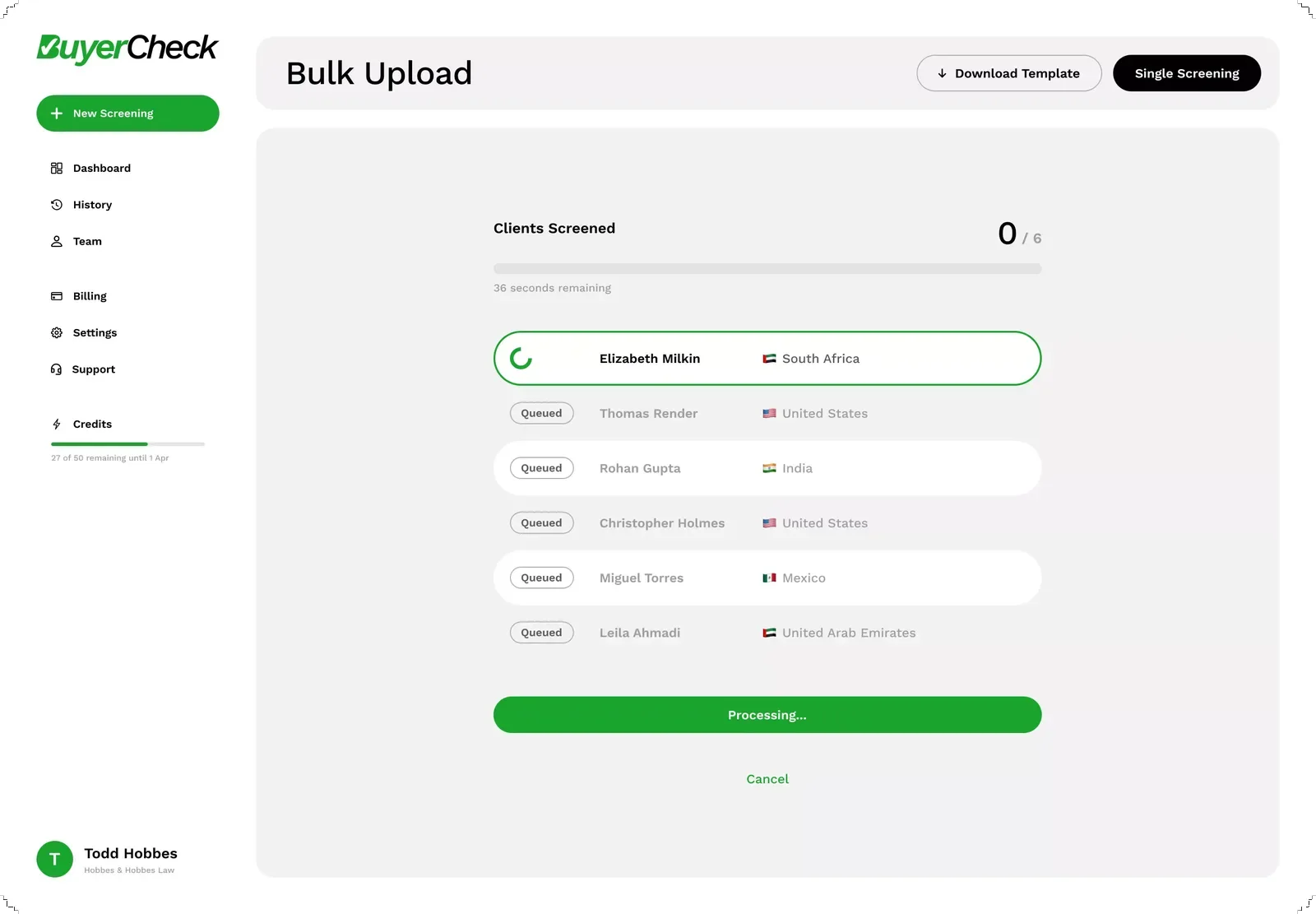
Bulk upload for high-volume agencies
06 / How it works
From buyer name to compliance record
- 01
Enter the buyer
Name, nationality, document, and the deal in one form, or a spreadsheet for many buyers.
- 02
Screen instantly
1,200+ global watchlists, sanctions lists, and PEP registries, plus law enforcement records and adverse media, checked at once.
- 03
Save the record
Time, risk, and broker logged to the agency’s history.
- 04
Report on demand
One click creates the enhanced report PDF for higher-risk buyers.
Availability is a compliance requirement too. Screening draws on 12 data APIs through two aggregators. During live testing, an outage at our only aggregator took screening offline, and a broker who can’t screen either stalls the deal or proceeds unscreened. I added a second one. Both are checked, the higher risk always wins when they disagree, and if one fails the other answers.
I built the product with Claude Code and Codex from detailed specs, in a cycle of define, build, check, and fix. Every query is limited to the broker’s own agency, and the screening engine, risk report, and audit trail were built as reusable pieces. The same codebase became ClientCheck, a client-screening platform for law firms and banks.
If either aggregator fails, the other answers on its own.
Technical implementation
- Frontend
- Next.js and TypeScript
- Database
- Supabase, Middle East region
- Access control
- Row-level security by agency
- Screening
- 12 APIs, 1,200+ watchlists
- Reports
- PDFKit
- Payments
- Stripe
- Resend
- Hosting
- Vercel
- DNS and security
- Cloudflare
- Monitoring
- Sentry
- Analytics
- Google Analytics
- Built with
- Claude Code and Codex
07 / Tradeoffs
What I built, and what I left out
BuiltFixed, weighted risk scoring that gives the same answer every time.
Left outAI-generated risk scores that no one could explain to a regulator.
BuiltInstant screening in the same session.
Left outResults by email after a review queue, the original design.
BuiltTwo data aggregators with conservative merging.
Left outA single aggregator, after an outage showed the risk.
BuiltA separate government tier with its own access and export.
Left outOne account type with different views, which couldn’t keep agencies’ data apart.
08 / takeaway
What I carry forward
In compliance products, the user experience and the regulation often pull in opposite directions. My job is to make them the same thing. When the official said brokers wouldn’t wait, he was really telling me what the product would be. Giving the user a clear answer they can trust, while treating compliance as the byproduct, drove every major decision in BuyerCheck.