
GoldChain is a B2B marketplace for traceable, ethically sourced gold. I designed it from field research through a closed pilot, and rebuilt it when the first version didn’t take.
goldchain.pro >01 / big idea
Make the sale the product, and tracking the receipt.
Everyone downstream wanted proof of where gold came from. The miners who had to create that proof had no reason to. GoldChain works because every participant comes for the trade, and the record of where the gold came from is produced along the way.
02 / my role
- Ran field research and usability sessions with miners, traders, and buyers
- Designed the information architecture, flows, and visual system
- Built the component library
- Built the platform with Claude Code and Codex
- Organized the closed pilot and ran follow-up interviews
- 4Roles in one system, producer, exporter, importer, and refiner
- 1Scan from a QR code to the full chain of custody
- 2Countries in the closed pilot, the DRC and the UAE
03 / Problem
The gold trade runs on trust gaps
Small-scale miners have no reliable path to legitimate buyers, and buyers can’t prove where gold came from.
Artisanal and small-scale mining produces about a fifth of the world’s gold and supports millions of miners, mostly in sub-Saharan Africa. The chain from mine to market is informal. Refineries and jewelers can’t verify origin before they pay, miners can’t reach fair prices, and smuggled gold mixes in with clean gold.
- Market failure
No trust between producers and buyers
Verification happens informally or not at all. Buyers take the risk or walk away.
- Regulatory gap
Rules on paper, not in practice
Responsible-sourcing guidelines exist, but nothing makes them achievable for a small mining cooperative.
04 / First version
A tracking tool for regulators
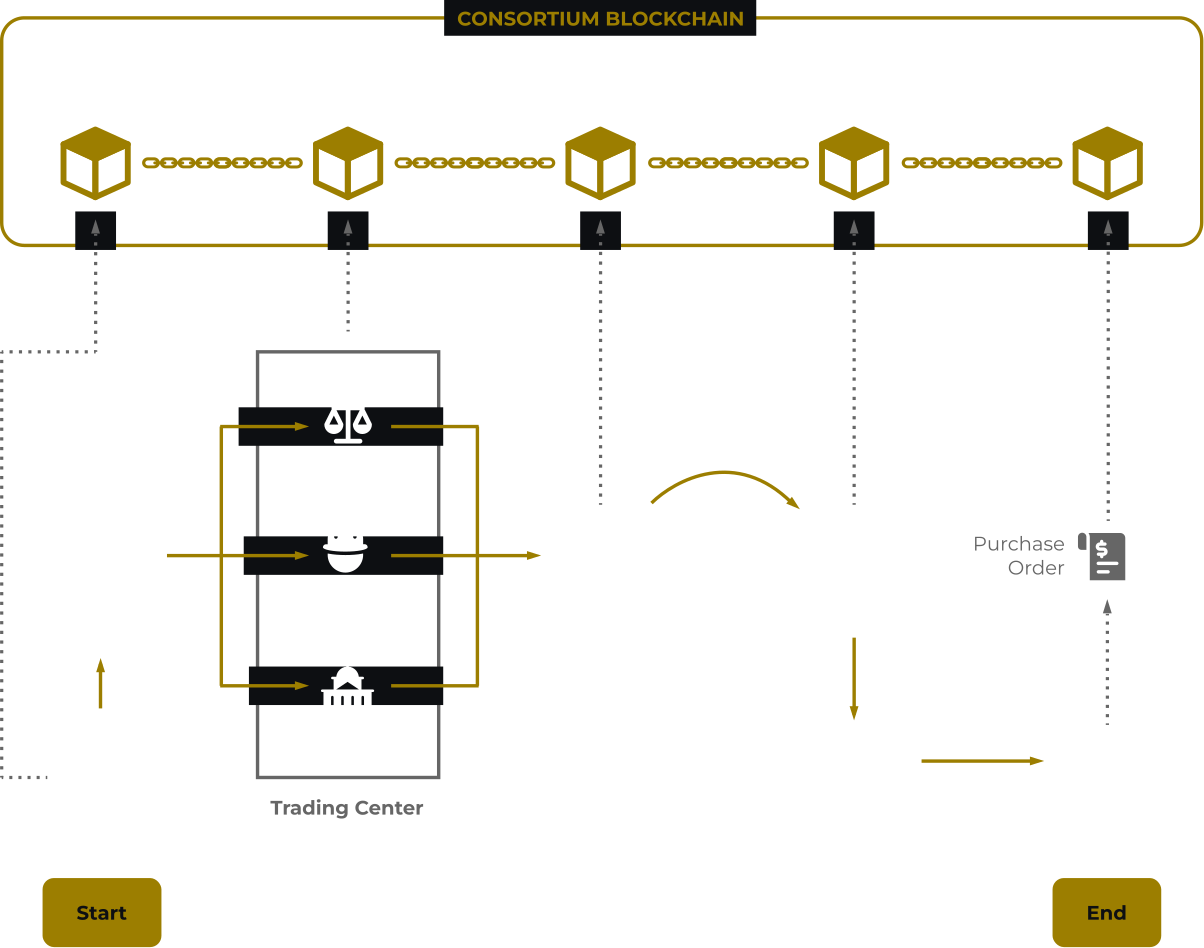
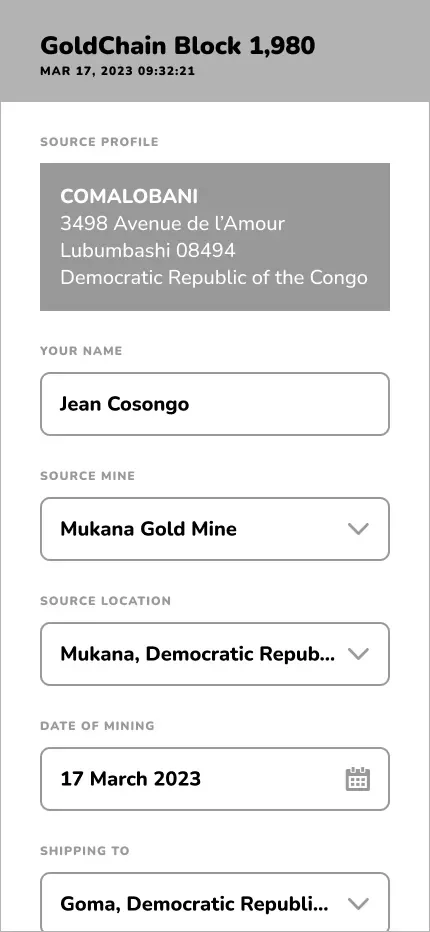
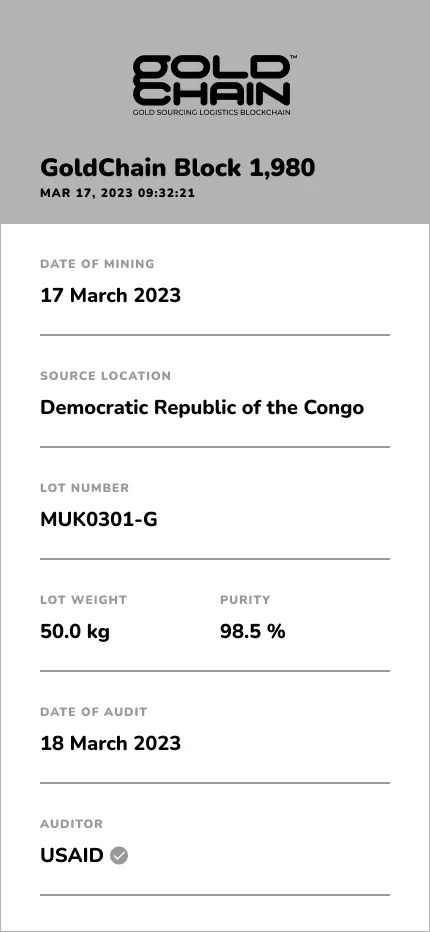
The first GoldChain made the ledger the product. Every handoff, from mine to refinery, was entered as its own block.
- 01
Web form
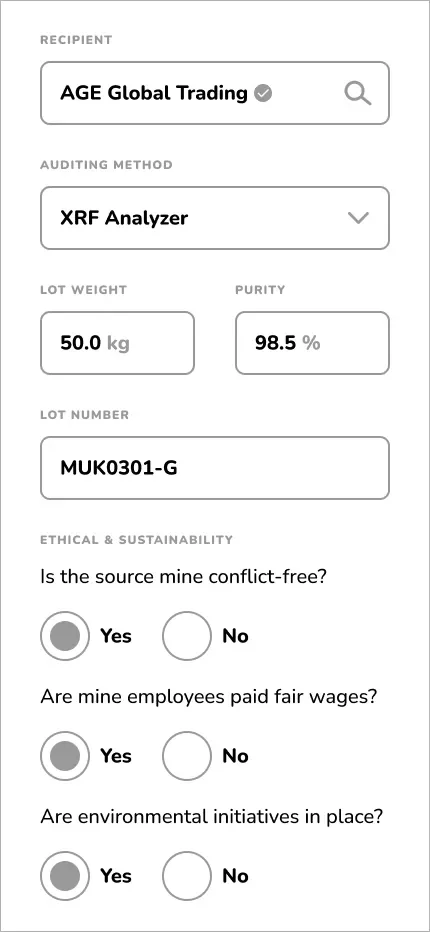
Collected transaction data for accounting and investors, replacing folders of PDFs.
- 02
Tracking app
Recorded every handoff from mine to exporter to importer to buyer, built for regulators.
- 03
Field test
Put it in front of the supply chain to see who would use it.
One form for every handoff
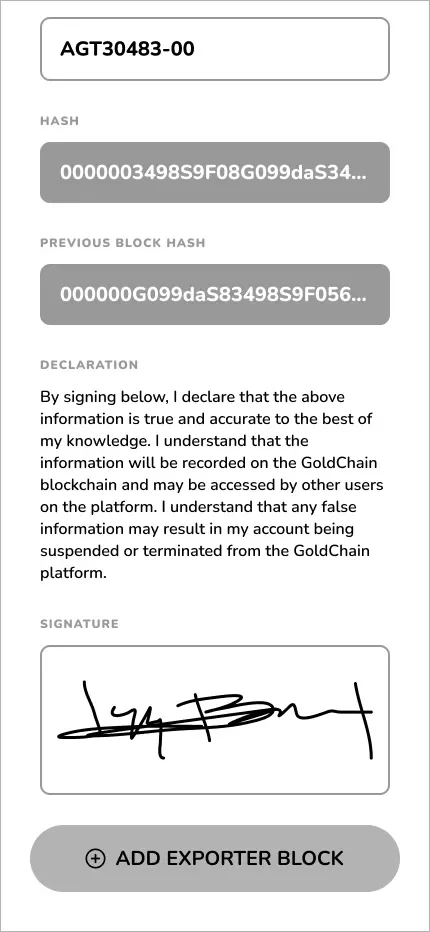
Each participant added a block when the gold changed hands, the source, the auditor, the exporter, and so on down the chain. Every block carried the lot, weight, purity, and a signed declaration, and linked to the block before it. It was a good idea. Regulators and buyers got exactly the record they had asked for. What it was missing was a reason for the miners at the start of the chain to fill it in.
05 / Key insight
Compliance is not a reason to log in
The field test split the supply chain in three, and the people who mattered most said no.
- End buyers
Engaged
Loved seeing origin and handling, but they only consume data. They can’t create it.
- Refineries and traders
Selectively interested
Some saw value, mainly those selling into regulated EU and US markets.
- Miners
Reluctant
Extra work with no economic return. Without them, the chain was incomplete.
We cut the miners’ part to two screens and made their accounts free, and they still had no reason to spend five minutes entering data. A tracking tool only works if the people creating the data want to use it. So I turned GoldChain into a marketplace. Producers list gold to reach verified buyers, buyers are protected by escrow, and every sale writes the tracking record that regulators and end buyers wanted all along.
Miners list to sell, not to comply. The compliance follows the commerce.
06 / Decisions
Complexity absorbed, not exposed
Users from rural cooperatives to Dubai trading desks share one product. None of them see a compliance framework, only their next step.
A marketplace people already understand
- Noticed
- Miners and buyers knew how to shop online, but not how to navigate commodity compliance.
- Decided
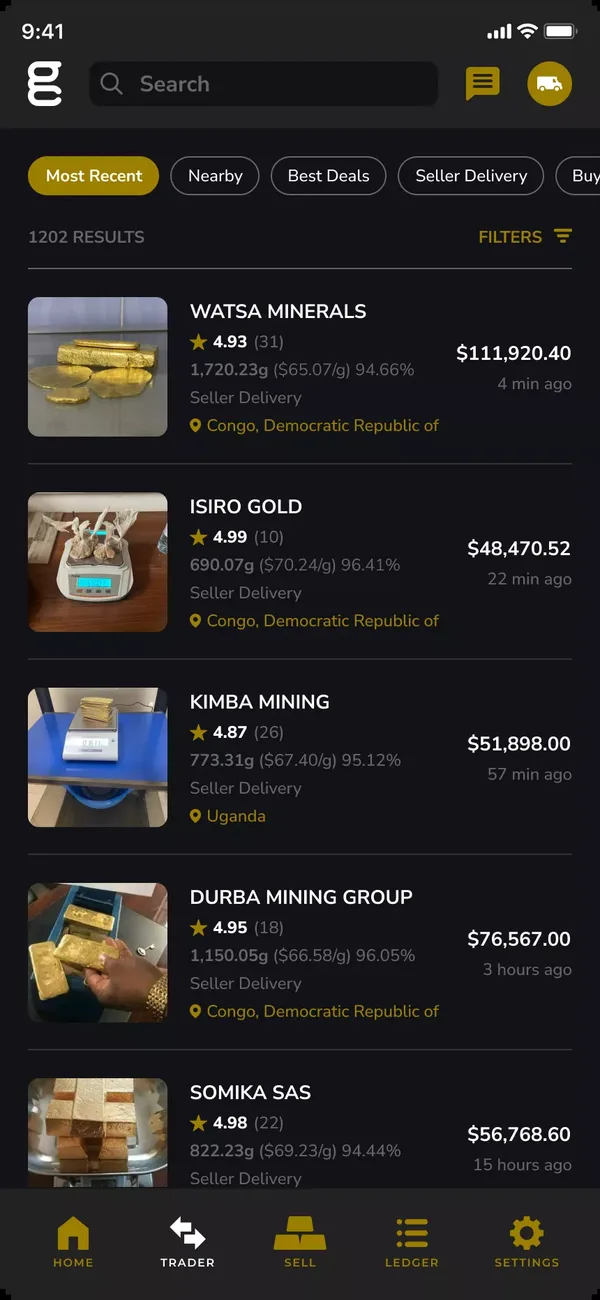
- Borrow the browse-and-buy pattern of a consumer marketplace, and layer in the signals that matter for gold, trust tier, certification, and quantity.
- Result
- Producers list to sell, and buyers see verification before they see price.
Listings with trust and certification up front 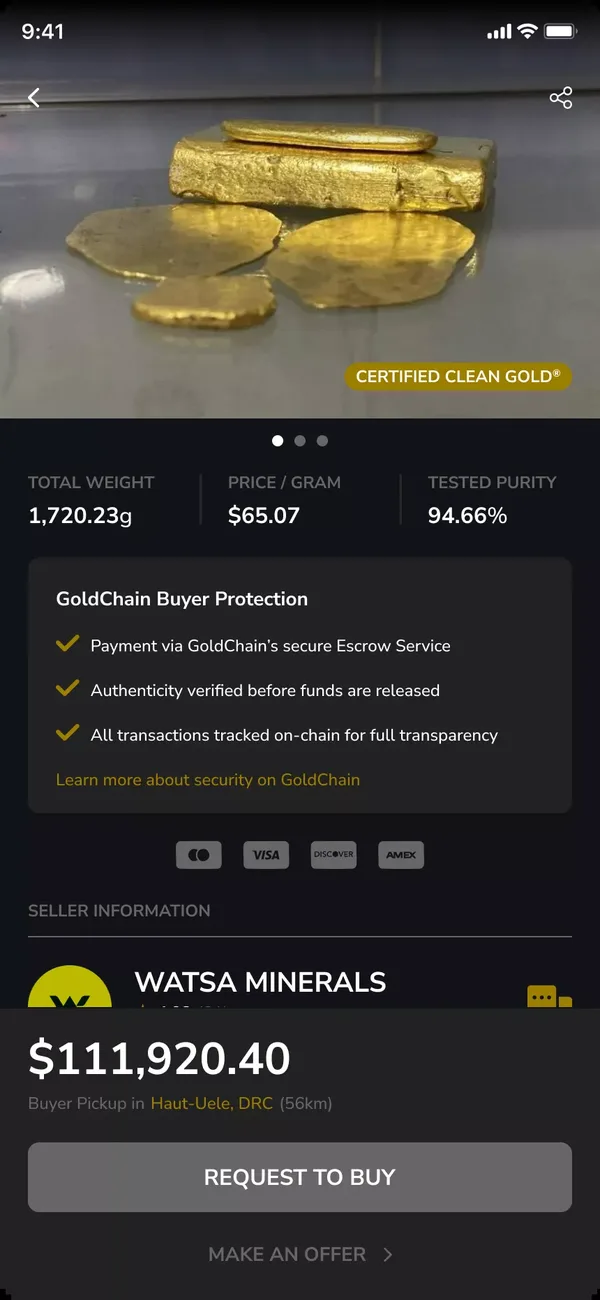
Buyer protection on every listing
Verification, one step at a time
- Noticed
- Showing the full list of documents up front made verification feel impossible for a small cooperative.
- Decided
- Reveal only what the next step needs, then give one clear review screen before anything is submitted.
- Result
- Producers finish listings with every document in place, without facing the whole requirement at once.
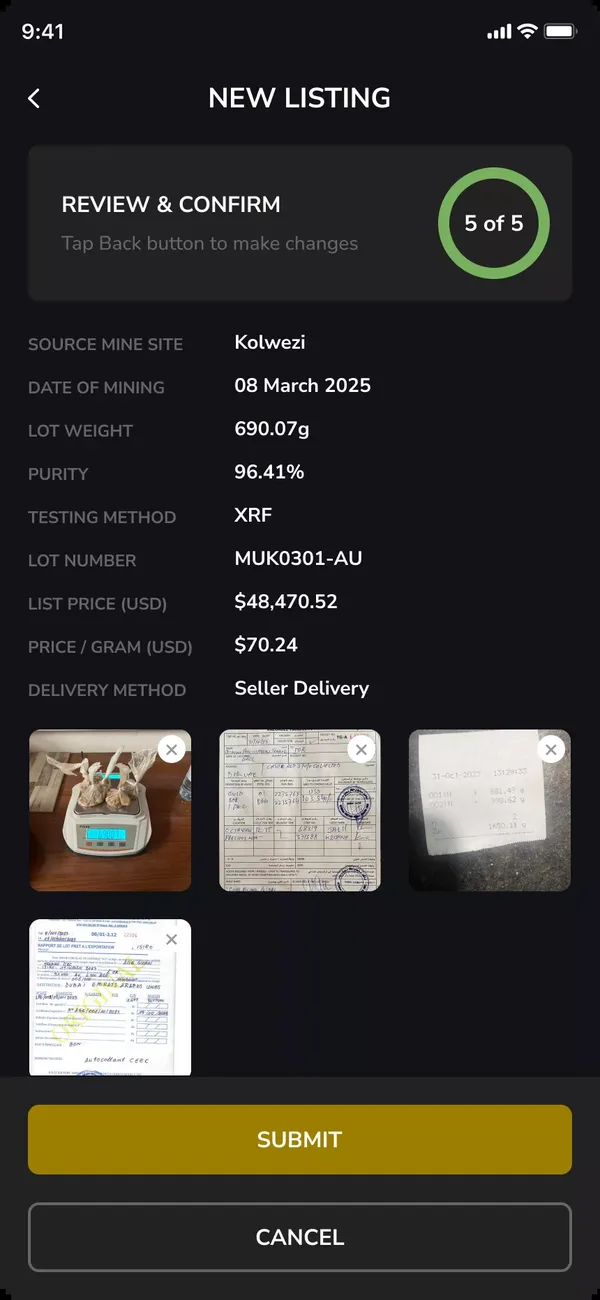
Review and confirm a new listing 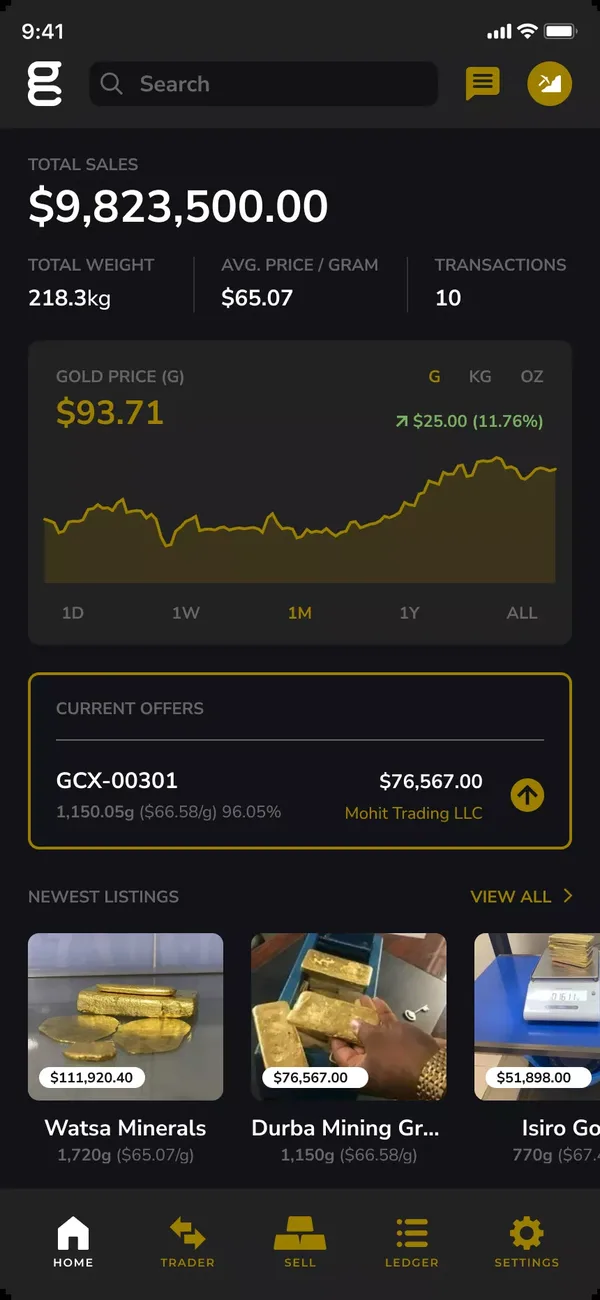
Seller dashboard and incoming offers
Protect both sides of the deal
- Noticed
- Sellers and buyers in new trade relationships had little reason to trust each other.
- Decided
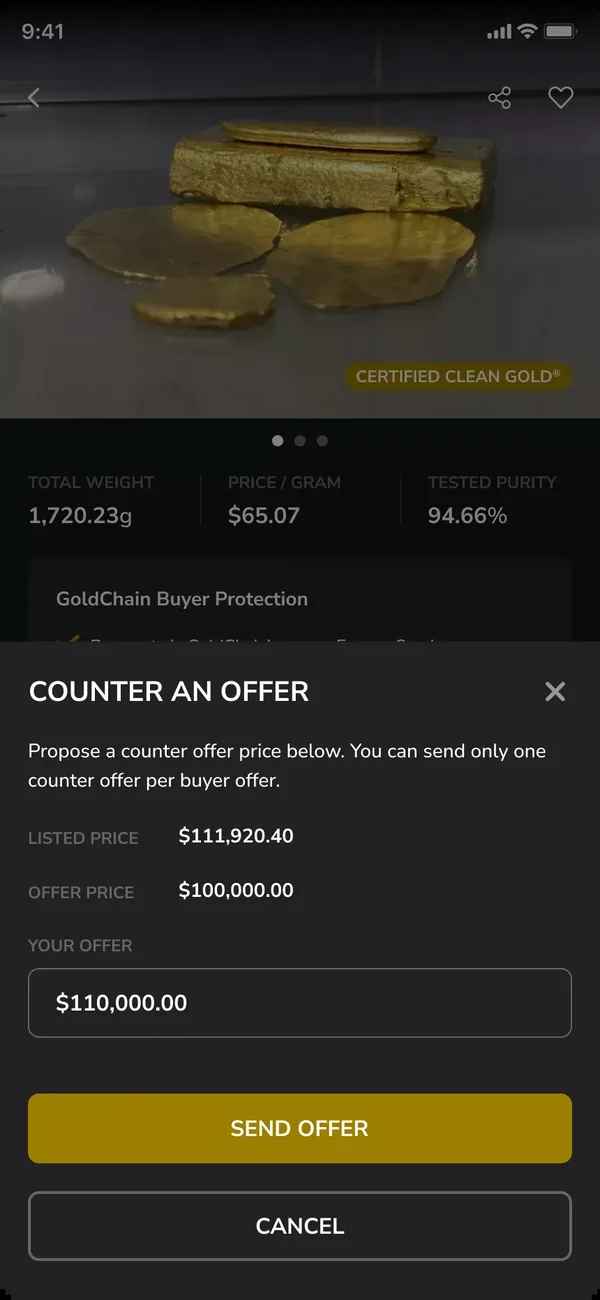
- Negotiate offers in the product with the listing in view, hold payment in escrow, and design the dispute flow before the happy path.
- Result
- Neither side has to take the other’s word for it, and a problem has a clear path to resolution.
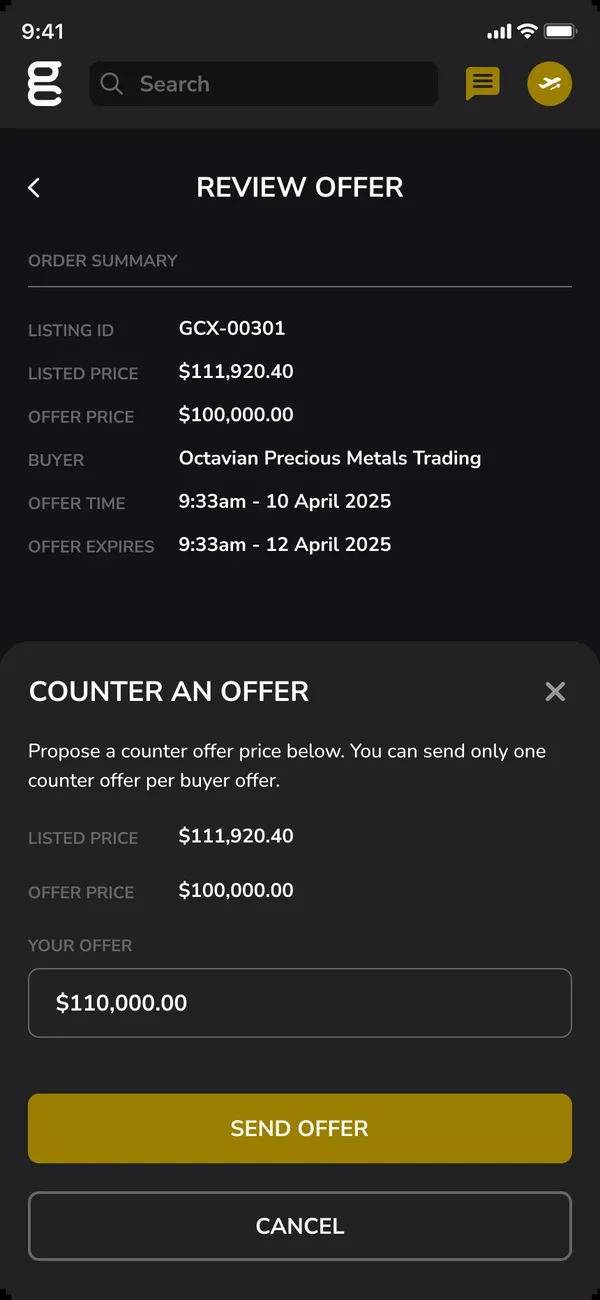
Counter an offer with the listing in view 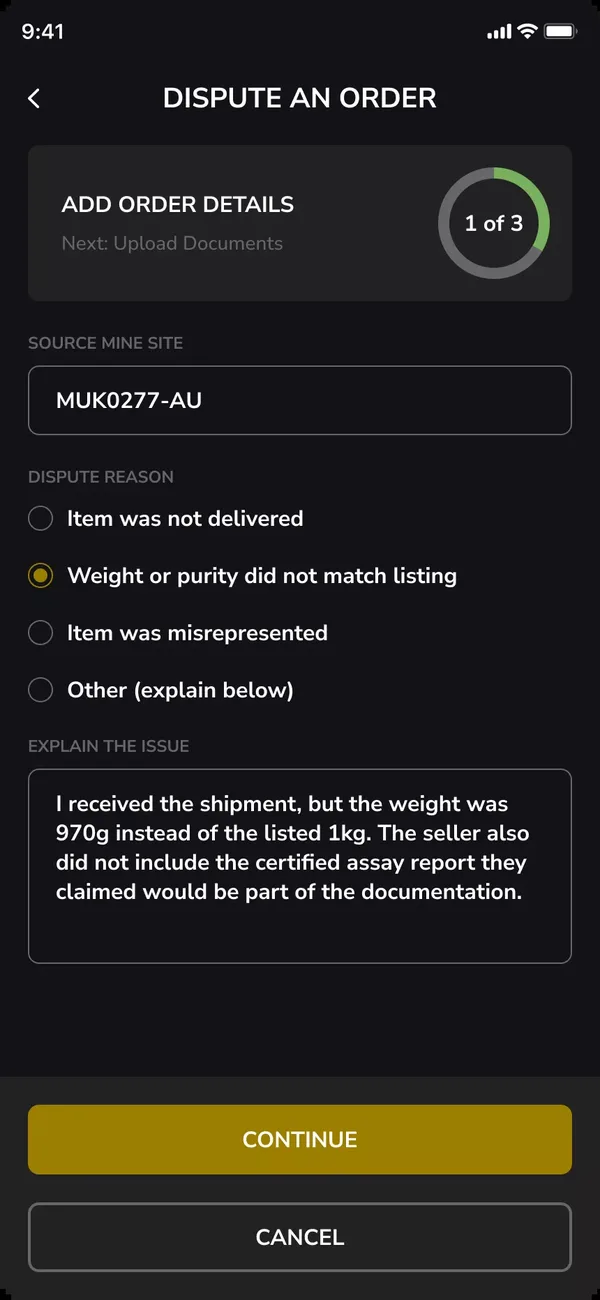
A structured dispute if delivery doesn’t match
Trust you can scan
- Noticed
- The tracking record had value beyond compliance. People buying jewelry or bullion want to know it was sourced responsibly.
- Decided
- Give every settled lot a QR code linked to a public provenance view, written for people, not auditors.
- Result
- Anyone, down to the end buyer, can see where their gold came from without an account.
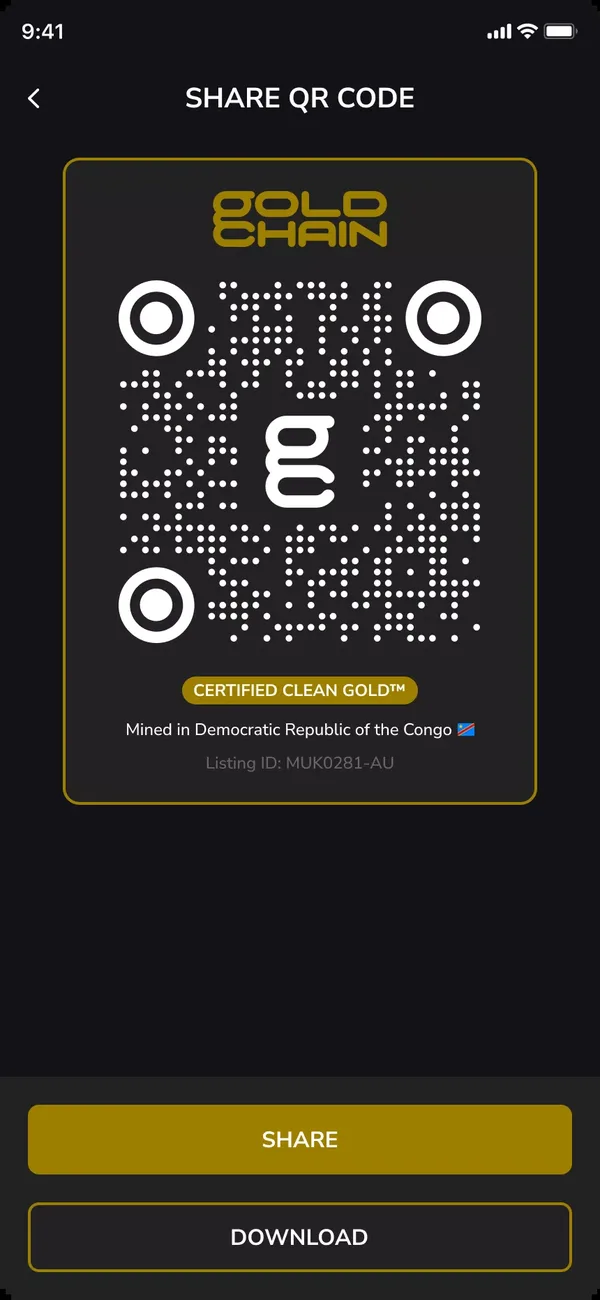
Every settled lot gets a QR code 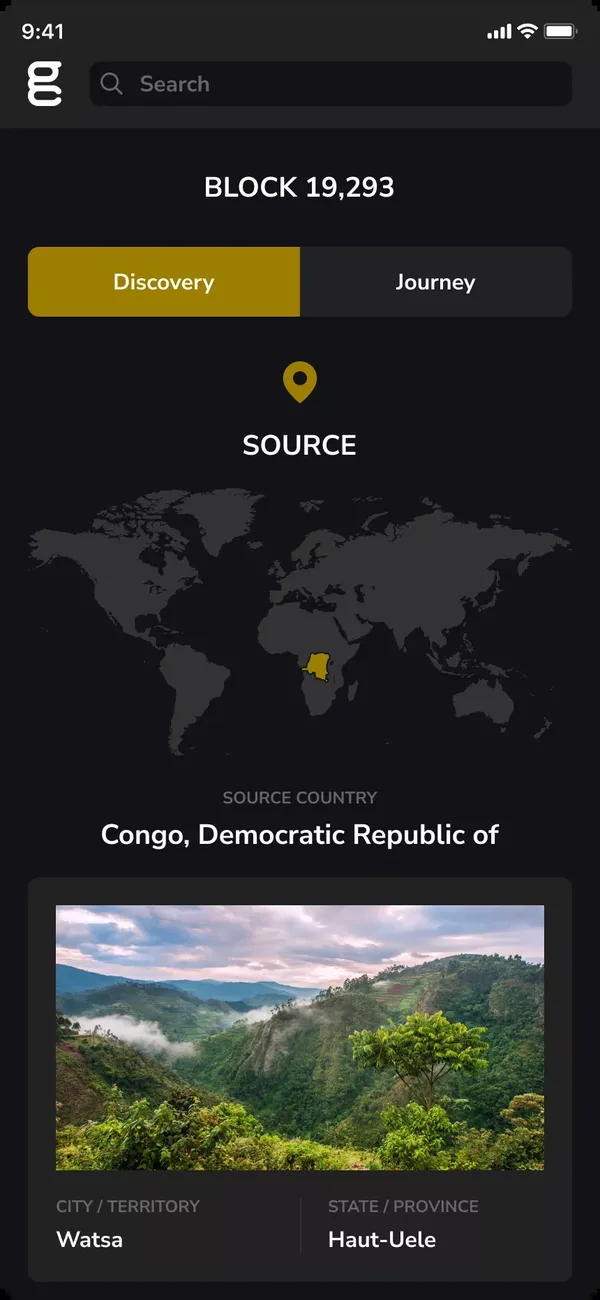
The public view any buyer can scan
One data model, a view for every role
- Noticed
- Producers, traders, buyers, and admins all touch the same transaction, with different permissions, and a mistake in a cross-border trade is expensive to undo.
- Decided
- Share one data model and give each role its own view of it. Make every action one tap, but nothing final without a confirmation, and give admins one place to see every verification, order, and flag.
- Result
- Every role sees what it needs and nothing it shouldn’t, and every admin action is logged.
Nothing is final without confirmation 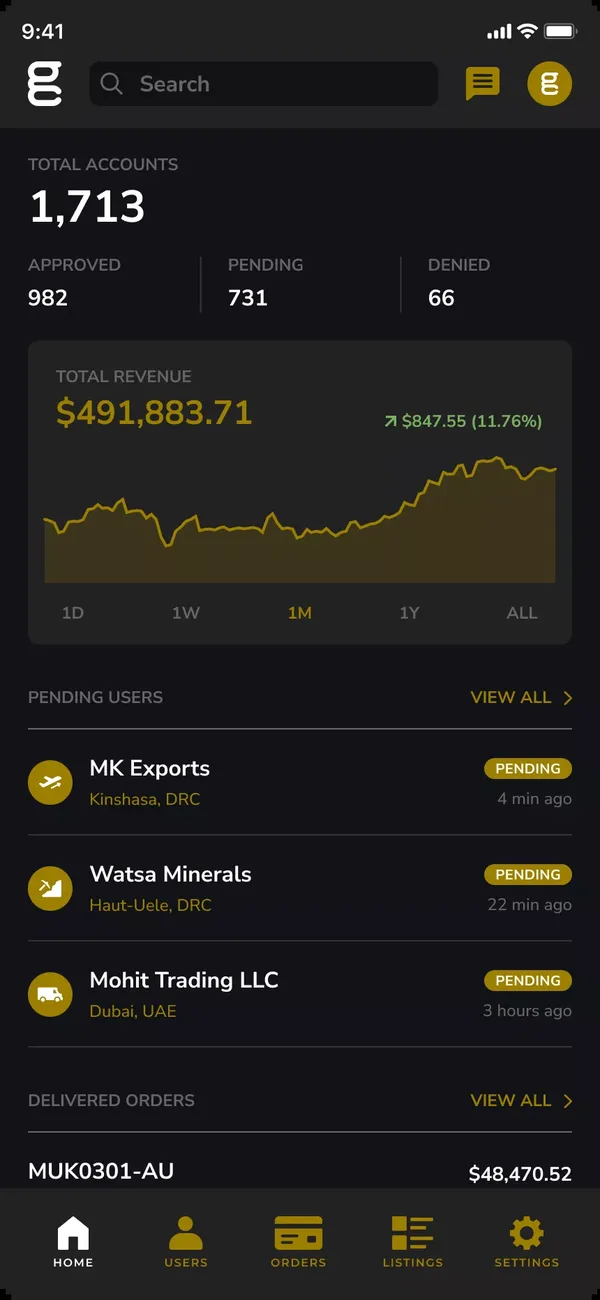
Admin oversight with an audit trail
07 / How it works
From listing to settlement
International trade paperwork, simplified into steps a rural mining cooperative can complete.
- 01
List a lot
Mine documents, weight, purity assay, and origin, with a reference ID for the lot.
- 02
Verify
Documents checked and the listing shown to approved buyers.
- 03
Make an offer
Buyers review the record, negotiate, and pay into escrow.
- 04
Confirm delivery
The buyer checks weight and quality against the assay, with a window for disputes.
- 05
Settle
Escrow pays out, the record is sealed, and a certificate is issued.
08 / Tradeoffs
What I built, and what I left out
BuiltEscrow on every sale. More friction, but it protects both sides and brings in institutional buyers.
Left outDirect payment between buyer and seller.
BuiltSupply first. Producers and exporters onboarded before buyer features opened.
Left outAn open marketplace during the pilot. Every participant is invited and verified by hand.
BuiltA B2B marketplace for licensed traders and professional buyers.
Left outSelling to consumers, which would have weakened verification and exposed trade pricing.
09 / Status
In a closed pilot
GoldChain is in a closed pilot in the DRC and UAE with one participant in each role, a producer, an exporter, an importer, and a refiner, under government oversight. The pilot tests the trust model before scaling, so I’m not publishing volume numbers until it ends.
10 / takeaway
What I carry forward
The first version was polished and technically sound, and the people at the start of the chain simply ignored it. That failure taught me more than any screen I designed. Trust and transparency don’t get adopted because they’re right. They get adopted when they’re built into something people have a reason to use.